
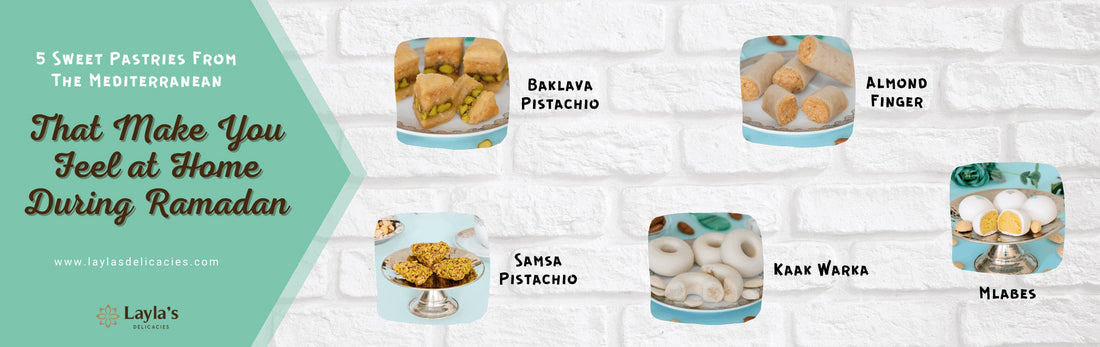
5 Sweet Treats From The Mediterranean That Make You Feel at Home During Ramadan
Something as simple and sweet as a little treat can stir up all sorts of feelings.
Why? Because of their association with memory. When you eat a treat that is synonymous with certain memories, it takes you back to that place, no matter where in the world you are.
The taste of the food— its smell and texture —can evoke powerful memories from the past. It makes you remember home and other places close to your heart.
Ramadan is an important season for Muslims worldwide. The sunrise to sunset fasting makes for heightened devotion and introspection.

Source: Unsplash
One of the best ways to mark iftar with family and friends is to savour some sweet treats like Kaak Warka and Baklava Pistachio.
These treats are a home away from home every time you take a bite. Thanks to Layla’s Delicacies, Ramadan in the US is just as special as it could get.
Mediterranean food is a worldwide favourite, and Mediterranean sweets have some distinct markers. One of them is the use of nuts. Nuts grow very well in the region and give these treats their rich, nutty flavour.

Source: Unsplash
Another marker of Mediterranean treats is the use of fresh fruit. Tropical fruits do well because of the warm climate. Many of these sweets are also not too sugary, so the natural flavours of the fruit and nuts can shine through.
Any cuisine originating from a certain region is influenced by several factors. They include:
- Ingredients available in the area - this includes plants, herbs, spices, flowers and any other components of dessert recipes. Some recipes are unique to certain regions because those areas had a climate suited to growing nuts and flowers that are used to prepare the dishes.
- The culture and religion of the people - especially the celebrations or ceremonies during which these desserts were eaten.
- Trade and migration in different regions. People in a region may begin eating certain types of foods or ingredients sold along certain trade routes. Also, as they migrate, they carry the recipes and culture to the places that they settle.
An example is how the Baklava recipe traveled across the Mediterranean from the Assyrian empire.
These factors influenced the development of the Mediterranean treats that we discuss below. Let’s look at some of these sumptuous treats that make you feel at home during Ramadan and all year long.
Baklava Pistachio

Baklava is one of the most famous of all Mediterranean treats. This layered dessert consisting of dough stretched out, layered with nuts and dipped in honey has its origins in the Assyrian Empire, about 3,000 years back.
As trade and conquests of that time expanded and empires grew closer to each other, the Greeks took to this sweet, nutty dessert. They put their twist on it, stretching the dough into thin, crispy golden layers, showing how thin and delicate the layers of dough were.
The Ottoman Empire rose in the 1500s and took over Greece. Baklava wasn’t left behind, it was prepared using spicy cinnamon and cardamom notes because of the trade routes that passed by the empire.
The empire stretched out to North Africa. Baklava became a mainstay on dessert trays during special occasions all over the Mediterranean, Arabian Peninsula, and North Africa.`
Today, Baklava has some identifiers regardless of where in the world it’s prepared. They include:
- A sweet filling of chopped nuts, especially pistachios, almonds or walnuts.
- Several thin, crispy golden layers above and below the nuts,
- A sweet glaze or syrup to bring it all together. The glaze can be honey or sugar syrup.
Here at Layla’s Delicacies, Baklava Pistachio is one of our most ordered treats. The chopped pistachios and almonds sit pretty between thin, crispy golden layers, all soaked in a lightly sweetened syrup.
Order here and enjoy it throughout Ramadan with family and friends.
Almond Fingers

As the name suggests, these treats are somewhat shaped like human digits. These flavor-filled treats are made of a blend of almonds and pistachio nuts, wrapped in thin, crispy golden layers.
These treats were originally from Morocco, but are loved all across the Mediterranean.
Holland also comes up often when this sweet treat is mentioned. In Italy, this snack goes by Ditti Di Mandorle. It’s been adapted into a variety of Mediterranean dessert recipe collections.
Almond fingers aren’t the same as ladyfingers, a treat that can be traced back to France. French settlers in America popularized ladyfingers.
The crunch of the thin golden layers around the almond fingers complements the almond and pistachio paste inside. It’s mostly enjoyed in the morning because its nutty taste goes well with coffee.
Enjoy these Almond Fingers during suhur - right at the break of dawn - before the holy fast begins.
Samsa Pistachio

Samsa is a very popular sweet in North Africa. These triangular treats don’t have a straightforward history. Etymologically, they’re very similar to samosas and have similar origins to them - in the Middle East and Central Asia.
Ibn Battuta, a Muslim Morrocan explorer documented an instance where he had a meal at the court of the Sultan of Dehli, Muhammud bin Tulghluq, in the 14th century. He described samushak as a pie filled with pistachios, almonds, walnuts and spices.
This is consistent with the delicious Samsa Pistachio that’s enjoyed today. There’s still a debate over where it came from. Regardless of its origin, this sweet treat is one that you deserve to enjoy.
This sweet treat has an outer layer of thin, crispy golden brik layers and a moist filling made out of a mix of crunchy almonds and hazelnuts. Pistachio nuts are sprinkled on top for a delightful sensory experience.
Get yourself some Samsa to break your fast, and pair it with some mint tea or coffee.
Kaak Warka

These treats are partaken of during any special occasion. You will almost always see these treats in every assortment of desserts at parties across the Mediterranean and in Muslim communities worldwide.
Kaak Waarka is said to have Andalusian origins, although this is not recorded anywhere. That’s okay— because once these treats melt instantly in your mouth— it won’t matter where they’re from.
Kaak Warka is traditionally made with flour, butter, water, almonds, rose water, and iced sugar. The dough is baked at low heat so it retains its white color and is filled with sweet almond paste or marzipan with rose water.
These sweet donut-shaped treats will bring joy to your family during this Ramadan. Buy Kaak Waarka, they make a special part of our limited edition collection. They’re a hit every year, so be sure to make your order early!
Bjewia Pistachio
Bjewia, also referred to as Bjewiya, is a unique treat that has its roots in the Mediterranean. It’s a mixture of almonds and pistachio nuts topped with dried rose petals. Eaten during celebrations such as weddings, Bjewia pistachio is a special treat to enjoy during the holy month of Ramadan.
Like most of our treats, it consists of more than 70% of nuts. Despite Bjewia being sweet, the high nut composition ensures that natural flavours reign supreme.
Layla’s Delicacies has the perfect Bjewia Pistachio for you today, in one of many speciality gift boxes. These boxes are crafted with excellence and full of a variety of treats including Bjewia Pistachio.
Get an Escape Box today and get lost in the sweetness this Ramadan. A vegan box is available, as an alternative. It is just as good and also has Bjewia Pistachio.
Mlabes

Source: laylasdelicacies.com | Instagram
This Mediterranean speciality is top tier. These square or round shaped desserts are to die for.
Mlabes are made of ground almond paste delicately wrapped in a thin meringue layer. The paste in the middle can be made of any ground nuts- hazelnuts and even mocha nuts. The meringue layer is flavoured with rose extract and perfumed with orange zest.
These treats are made using a variety of ingredients. Originally from the city of Sfax, Mlabes have been in different civilizations and the recipe has been refined over generations.
They are also decorated with a silver leaf which is like a crown, an ode to their royalty.
This Ramadan, gift your family and friends with these delicious royal sweets. They’re available on a seasonal basis, so contact us here so that you don’t miss out on this nutty goodness.
Our recipes are one of a kind and come in handy during Ramadan when communal meals are commonplace. Layla’s Delicacies is committed to ensuring that your guests and family are thoroughly impressed and satisfied this year.
Celebrate Ramadan in style, the Layla’s Delicacies way.
Ramadan Kareem, may Allah accept all your duas and wishes and bless your family.